lunes, 17 de febrero de 2014

Las distintas connotaciones mentales de las palabras "gasto" e "inversión"

Al respecto de los efectos "framing", leed esta entrada del blog "HETECONOMIST" en que se reflexiona sobre la diferente resonancia mental de las palabras "gasto" e "inversión" a la hora de considerar el gasto y el déficit público


Effect on the Mind of the Words "Spending" and "Investing"

In a recent talk based on a paper by Louisa Connor and Bill Mitchell, Mitchell considers the way in which the mainstream framing of the economy serves the neoliberal ideological agenda and how the framing could be altered to suit progressive viewpoints. Among the examples he gives are the terms "government spending" and "budget deficit".
Acceptance of the term "budget" in connection to the government's fiscal policy suits the neoliberal effort to maintain a false analogy between a financially constrained household and a sovereign government. A "budget deficit" probably seems bad, even unaffordable, a "budget surplus" good, to anyone taken in by the folksy neoliberal nonsense, so much so that these positions would strike many as "common sense". In numerous instances the opposite of the truth appears to be widely regarded as gospel, such as the misconception that surpluses add to saving when of course the reverse is the case.
The concern with the term "government spending" is the associations it apparently conjures in the minds of many. Spending something is taken to mean it is "gone" or "wasted". Mitchell suggests it would be better to refer to government "investing" both for government consumption and investment expenditure. It seems that to the human mind, to invest is to "build up", to spend is to "use up".
Meanings or associations of the word "invest" include to commit money to obtain a return; to devote morally or psychologically to a purpose; to endow with authority or power.
Government spending should always be an investment in the sense that it enhances the capabilities, opportunities and freedom of individuals to reach their full potential. A sovereign government has the capacity to empower individuals and communities through the investments it makes.
The example of the effect on the human mind of the words "spending" and "investing" is reminiscent of an interesting passage in volume 2 of Capital (ch.19, section II.4):
The labourer sells his commodity -- labor-power -- to the capitalist; the money with which the capitalist buys it is from his point of view money invested for the production of surplus-value, hence money-capital; it is not spent but advanced. (This is the real meaning of "advance" -- the avanceof the physiocrats -- no matter where the capitalist gets the money. Every value which the capitalist pays out for the purposes of the productive process is advanced from his point of view, regardless of whether this takes place before or post festum; it is advanced to the process of production itself.) The same takes place here as in every other sale of commodities: The seller gives away a use-value (in this case his labour-power) and receives its value (realises its price) in money; the buyer gives away his money and receives in return the commodity itself -- in this case labour-power.
Evidently the capitalists, at least according to Marx, do not like to think of themselves as spending, just as the public apparently does not like the idea of the government spending. People prefer to see themselves as investing or advancing.
Other meanings or associations of the word "advance" include to move forward in a purposeful way; to make progress or cause to make progress; to develop or improve.
Just as capitalists advance money in return for the commodity labor-power, government when it consumes or invests advances its money in return for a good or service.
Taking the analogy a step further, just as the invested or advanced wages paid to workers return (in large part, at least) to capitalists as a class when workers spend on consumption items, government investments or advances return to the government, ultimately, as tax revenues.
The advances, of course, should be sufficient to enable net saving when this fiscal choice better supports the intentions of the community.

viernes, 14 de febrero de 2014

El juego de la muerte

Carlota Ramírez nos manda este texto con un video que merece la pena ser visto


El Juego de la Muerte

http://informacionporlaverdad.files.wordpress.com/2012/01/el-juego-de-la-muerte.jpg?w=300&h=171El Juego de la Muerte es un documental impactante que sigue a 80 personas que se presentan voluntarias para participar en el piloto de un nuevo concurso de televisión y que, sin saberlo, están participando en un experimento similar a los que Stanley Milgram realizó en Yale en los años sesenta para estudiar el impacto de la autoridad en la obediencia de la población.

En este concurso, una glamurosa presentadora ordena a los concursantes que realicen descargas eléctricas a sus compañeros de juego cada vez que éstos fallen las preguntas de un cuestionario. El concurso comienza y, mientras tanto, un grupo de psicólogos analiza los inquietantes resultados.
Aunque el concurso es una farsa y las descargas eléctricas no son reales, ni el público en el plató ni los participantes lo saben. Parte del juego les obliga a convertirse en torturadores, realizando descargas eléctricas hasta niveles casi letales. El concurso avanza, la presión del público y de la presentadora es fuerte. Realizarán descargas eléctricas los concursantes?, ¿hasta qué extremo serán capaces de llegar? ¿Qué estaríamos dispuestos a hacer si una figura de autoridad nos lo ordenara?
Este controvertido documental generó titulares de prensa por todo el mundo tras su reciente estreno en la televisión francesa. El experimento que muestra El juego de la Muerte es una llamada de atención sobre la obediencia ciega a la autoridad y el poder de manipulación de la televisión.

Video de YouTube que muestra es experimento subtitulado: 

miércoles, 12 de febrero de 2014

El precio de una actividad destructiva

Una cuestión sin duda apasionante, que ha sido tratada múltiples veces por la literatura, el cine y el periodismo, es el ilegal mercado de la violencia personal. La cuestión es muy simple y es la de que cuántos recursos debemos dedicar a alquilar a un "trabajador" para realizar por uno mismo una actividad destructiva, como es la de asesinar a otra persona.
La respuesta, obviamente, dependerá de las condiciones de oferta y demanda, por lo que el "salario" de un sicario variará según el mercado. No costará lo mismo un asesino a sueldo en Colombia que en Alemania. El artículo que subo a continuación nos cuenta cuánto cuesta un "hitman" en un país como Australia, y más importante, por qué razones la gente demanda asesinos a sueldo.

In 2003 researchers at the Australian Institute of Criminology dug through a decade’s-worth of old newspaper records, undercover police operations, and homicide databases to study the price and motivations of hiring a hitman. 
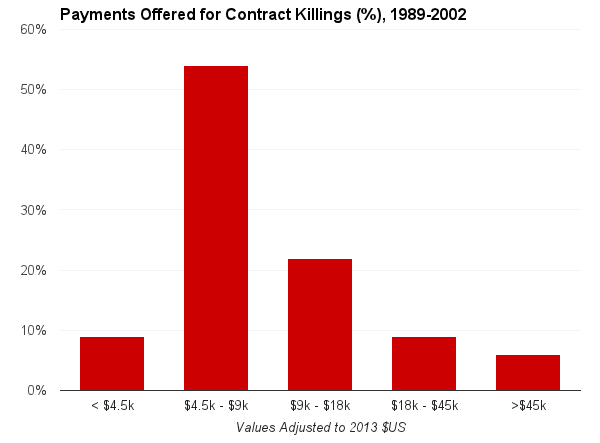
According to this study, the average payment to a hired killer was about $15K (converted to US dollars) and over half of all hitmen got less than $9K for their services:
This is a remarkably little amount of money for someone to commit a very serious (and risky crime). Thankfully, only 7 out of 10 attempted hits are actually successful according to the data set.
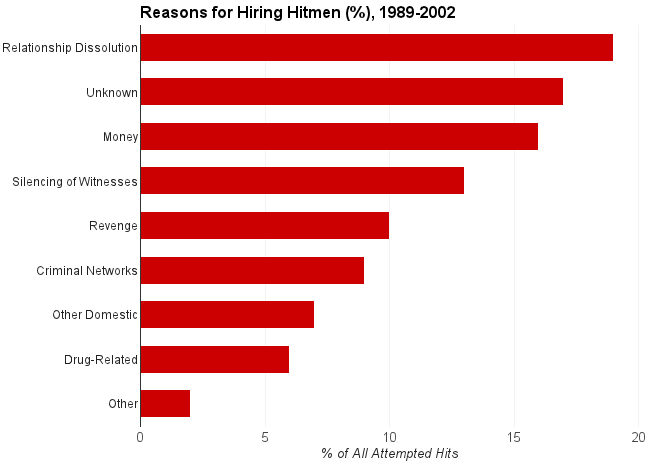
But why are people looking for hitmen, anyways? Hollywood may have trained us to think gangs, drugs, and assassination attempts, but relationship issues were the most common motivations:
Almost 20% of the attempted hits were due to impending divorce, break-up, or cheating spouses. In contrast, less than 10% were linked to criminal networks, and 6% were drug-related. 
Obviously, Priceonomics readers are not looking to become assassins, but here we have some very clear data that this form of crime does not pay.

martes, 11 de febrero de 2014

Sobre el dar dinero como fuente de felicidad

¿Que hace más feliz a la gente? ¿Gastarlo en uno mismo o "gastarlo" en otros, o sea, darlo a otros?

Be Happier: Spend More Money on Others

TOM JACOBS en la revista Pacific Standard (5/2/2014)

A round-up of recent research finds spending money on others can satisfy basic psychological needs and boost happiness.
•
If you want to feel happier—and who doesn’t—what should you do with that $20 you have in your pocket?
The evidence is clear, according to a new research paper: You should use it to help someone in need.
Psychologists Elizabeth Dunn and Lara Aknin, along with Michael Norton of Harvard Business School, report that the benefits of helping others “are evident in givers old and young in countries around the world, and extend to not only subjective well-being, but also objective health.”
Writing in the journal Current Directions in Psychological Science, they demonstrate this counter-intuitive thesis by describing a series of studies, many of which they conducted themselves.

The benefits of helping others “are evident in givers old and young in countries around the world, and extend to not only subjective well-being, but also objective health.”

The researchers begin by summarizing their own 2008 study, in which participants were given either $5 or $20 to spend by the end of the day. Half were instructed to buy themselves something; the others used it help out somebody else.
“That evening, people who had been assigned to spend the money on someone else reported happier moods over the course of the day than did those people assigned to spend the money on themselves,” they report.
They also point to a 2012 study, co-authored by Aknin, which found evidence that even young children feel happiness giving to others. Toddlers just under the age of two “exhibited more happiness” when they gave away goldfish crackers to a puppet character, compared to when they received the snacks themselves.
What’s more, this relationship does not seem to be exclusive to the U.S. or other wealthy nations. Aknin looked at data for 136 countries, and found “a significant relationship between giving and happiness” in 120 of them, “poor and rich alike.”
The researchers concede that other evidence suggests giving to others does not automatically increase happiness. So under what specific circumstances does this positive dynamic occur?
They find a likely answer in self-determination theory, which states that “human well-being depends upon the satisfaction of three basic needs: relatedness, competence, and autonomy.” Under the right circumstances, giving money can meet all three.
Regarding relatedness, “we found that individuals garner more happiness from pro-social spending when giving provides the opportunity to connect with other people,” they write. The need to demonstrate competence can be met “if people can see how their generous actions have made a difference.” And the “need for autonomy is satisfied when people feel that their actions are freely chosen.”
That last point is supported by a 2010 study that found “people experienced happier moods when they gave more money away—but only if they had a choice about how much to give.”
The researchers argue that these insights can be of use to charities and other organizations asking for donations. The more they “can maximize the emotional benefits of giving,” the more likely the donor will give additional dollars the next time they are asked.
So non-profits may benefit from promoting helpful activities one can do with a friend, such as a clean-up-the-beach day, or an afternoon accepting pledges at your local public radio station.
And they can help people see the impact of their donation by designating it for a specific, concrete purpose. As the researchers note, the vague notion of “improving children’s health” is far less satisfying than the specific image of buying bed nets to prevent Third-World kids from getting malaria.
An intelligently designed charitable appeal doesn’t guilt us into giving: It provides a framework that allows us to feel good about ourselves while we help others. And that’s a very happy combination.

sábado, 1 de febrero de 2014

Racionalidad de los consumidores

Pablo Parra me envía el siguiente con información útil para todos y que inaugura la nueva temporada de nuestro blog. Gracias, Pablo

"Estaba repasando los apuntes de clase y encontré este documental que cuestiona la racionalidad de los consumidores cuando en realidad nos dominan las emociones. Quizás sea interesante para los compañeros"

http://youtu.be/mjL1c4FnEzw